

If you’re planning to work in Poland, it’s important to understand the difference between gross and net salary. Job offers usually show the gross amount, but your net salary is what you actually receive after taxes and social security contributions. In this guide, you’ll learn how salaries are calculated in Poland, why your take-home pay is lower than your gross salary, and what to look for before accepting a job offer.
Contents
- Gross vs net salary in Poland – what’s the difference?
- Why is your net salary lower than your gross salary?
- Gross vs net salary – practical examples
- Which salary should you compare in job offers?
- How Intraservis Job helps you understand your salary
- Summary – know your real salary before coming to Poland
Gross vs net salary in Poland – what’s the difference?
When looking for a job in Poland, you will usually see the salary presented as a gross amount. This is not the amount that will be transferred to your bank account. To understand how much you will actually receive, you need to know the difference between gross and net salary.
What is the gross salary?
Gross salary is the total amount agreed with the employer before mandatory deductions are made. In Polish job offers and employment contracts, remuneration is usually presented as a gross amount.
Deductions from gross salary may include social security contributions, health insurance contributions, and personal income tax. These amounts are calculated before the employee receives their monthly payment.
This means that a salary of 5,000 PLN gross does not equal 5,000 PLN transferred to your account.
What is net salary?
Net salary, also called take-home pay, is the amount that remains after taxes and insurance contributions have been deducted from the gross salary. This is the money you actually receive in your bank account.
The final net amount depends on several factors, including the type of contract, tax reliefs, age, and individual insurance situation. For this reason, two employees with the same gross salary may receive different net payments.
Before accepting a job in Poland, foreign workers should check both the gross salary shown in the offer and the estimated net amount they will receive each month.
The difference between gross and net salary comes from mandatory deductions required under Polish law. Before your salary is paid, part of the gross amount is used to cover taxes and social security contributions. These payments help finance the public healthcare system, pensions, and other social benefits.
Although the deductions reduce your take-home pay, they also give you access to benefits such as public healthcare, sick pay, maternity benefits, and future pension rights when you meet the legal conditions.
Why is your net salary lower than your gross salary?
The difference between gross and net salary comes from mandatory deductions required under Polish law. Before your salary is paid, part of the gross amount is used to cover taxes and social security contributions. These payments help finance the public healthcare system, pensions, and other social benefits.
Although the deductions reduce your take-home pay, they also give you access to benefits such as public healthcare, sick pay, maternity benefits, and future pension rights when you meet the legal conditions.
Taxes and social security contributions
Several mandatory contributions are deducted from your gross salary before you receive your net pay. These include pension insurance, disability insurance, sickness insurance, health insurance, and, where applicable, personal income tax (PIT).
The rules for calculating these deductions are set out by the Polish Social Insurance Institution (ZUS) and the Ministry of Finance. The exact amount deducted depends on factors such as your salary, employment contract, tax reliefs, and personal circumstances.
Because these deductions are calculated automatically by the employer, employees do not have to make separate payments themselves.
Who pays additional employment costs?
Many foreign workers are surprised to learn that the cost of employing someone is higher than the gross salary shown in the contract. This is because employers also pay additional mandatory contributions that are not deducted from the employee’s salary.
These employer-funded contributions include additional social insurance payments, the Labour Fund, and other statutory charges required by Polish law. Detailed information is available from the Social Insurance Institution (ZUS).
For example, if your contract states a salary of 6,000 PLN gross, your employer’s total employment cost will be higher than 6,000 PLN. However, these additional contributions do not reduce your net salary—they are paid separately by the employer.
Gross vs net salary – practical examples
Knowing the difference between gross and net salary is much easier when you see real examples. While the exact amount you receive depends on your personal situation, approximate calculations can help you understand what to expect before accepting a job offer.
The examples below are based on a standard employment contract (umowa o pracę) and are intended for illustrative purposes. You can always calculate your estimated take-home pay using the official gross-to-net salary calculator provided by the Polish Public Employment Services.
Example calculations
Here are approximate monthly salaries under a standard employment contract:
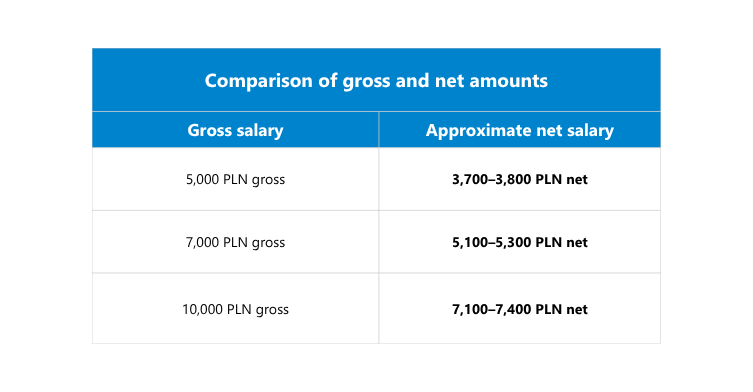
These figures are estimates only. The exact amount may vary depending on your tax situation and the deductions that apply to your employment.
Why your net salary may be different
Your net salary is not calculated using only your gross pay. Several factors can increase or decrease the amount you receive each month.
For example, your take-home pay may differ because of:
- your age, as workers under 26 may qualify for the Young People’s Tax Relief,
- the type of employment contract,
- the amount of tax and insurance contributions deducted from your salary,
- your individual tax situation or available tax reliefs.
This is why two employees earning the same gross salary may not receive exactly the same net amount. Before signing a contract, it is always worth asking your employer or recruitment agency for an estimated net salary so you know how much money you can expect to receive each month.
Which salary should you compare in job offers?
When comparing job offers in Poland, it is important to understand which salary figure you are looking at. Most employers advertise the gross salary, but the amount that matters most for your monthly budget is the net salary you will actually receive.
Knowing both figures helps you compare offers more accurately and avoid misunderstandings before starting work.
Why most job offers show gross salary
In Poland, salaries are generally presented as gross (brutto) because employment contracts and payroll calculations are based on this amount. Gross salary provides a standard way for employers to present remuneration, regardless of each employee’s personal tax situation.
Since net salary depends on factors such as taxes, insurance contributions, tax reliefs, and the type of employment contract, employers cannot always display one exact net amount that applies to every candidate.
General information about employment conditions and remuneration is available on the official State Labour Inspectorate (PIP) website.
Always ask about your estimated net salary
Although job advertisements usually show the gross salary, you should always ask how much you are expected to receive after deductions. This gives you a clearer picture of your monthly income and helps you plan your living expenses in Poland.
A reliable employer or recruitment agency should be able to explain:
- your estimated net salary,
- which deductions will be made,
- the type of employment contract,
- whether any bonuses or additional payments are included.
At Intraservis Job, candidates receive clear information about both the gross salary offered by the employer and the estimated net salary before signing a contract. This allows you to understand your expected earnings and make an informed decision before coming to work in Poland.
How Intraservis Job helps you understand your salary
Moving to another country for work is a big decision, and knowing how much you will actually earn is just as important as finding the right job. At Intraservis Job, we believe that every candidate should clearly understand their salary before arriving in Poland.
Our goal is to make the recruitment process transparent. We explain how salaries are calculated, what deductions may apply, and what you can realistically expect to receive each month. This allows you to plan your budget and avoid unexpected surprises after starting work.
Clear salary information before you start working
Before you sign your employment contract, our recruitment team explains both the gross salary offered by the employer and the estimated net salary based on your employment conditions.
We also provide information about:
- the type of employment contract,
- working hours and overtime rules,
- bonuses or additional payments,
- the estimated monthly take-home pay.
This means you know what to expect before you travel to Poland and can compare different job offers with confidence.
Support with contracts and payroll questions
Our support does not end once you arrive in Poland. If you have questions about your employment documents or salary, our team is available to help.
We can explain:
- your employment contract,
- monthly payslips,
- salary deductions,
- social security and health insurance contributions,
- holiday pay and other employment-related payments.
We want every worker to understand how their salary is calculated and to feel confident that they are employed legally and transparently.
Find jobs with clear salary information
If you are looking for legal employment in Poland, you can browse current vacancies published by Intraservis Job. Every offer includes key information such as the position, location, employment conditions, and salary, helping you compare opportunities before applying.
Examples of jobs you can feature here:
New job opportunities are added regularly, so you can choose the offer that best matches your experience, skills, and career plans.
Summary – know your real salary before coming to Poland
Understanding the difference between gross and net salary is one of the most important steps before accepting a job in Poland. While employers usually advertise gross pay, your net salary is the amount that will actually be transferred to your bank account each month.
By comparing both figures, you can better estimate your monthly budget, avoid misunderstandings, and make more informed decisions when choosing between job offers. If anything is unclear, don’t hesitate to ask your employer or recruitment agency to explain how your salary is calculated before signing the contract.
Gross salary is important, but net salary is what you receive
Gross salary is the starting point for calculating your earnings, but net salary is what determines how much money you will have for everyday expenses, accommodation, transport, and savings.
Before coming to Poland, make sure you understand both amounts and choose employers who provide clear and transparent salary information. This will help you start your new job with confidence and avoid unexpected surprises after your first payday.
If you’re looking for legal jobs in Poland with transparent employment conditions and clear salary information, browse the latest vacancies on the Intraservis Job, job offers page and find the opportunity that matches your skills and experience.