

More than 1.1 million foreigners are currently working in Poland. According to the latest Statistics Poland (GUS) data, 1.119 million foreign nationals were employed in Poland at the end of January 2026, an increase of 7.1% compared with the previous year. Ukrainians and Belarusians remain the largest groups, but the number of workers coming from Asian countries such as the Philippines, India, Nepal and Indonesia is also growing. Production, logistics, warehousing and construction are among the key sectors offering employment opportunities to international workers.
Spis treści:
- More than 1.1 million foreigners are working in Poland
- Where do foreign workers in Poland come from?
- What jobs do foreigners find in Poland?
- Why more foreigners choose Poland for work
- Is Poland a good place for foreign workers in 2026?
More than 1.1 million foreigners are working in Poland
Poland’s labour market is becoming increasingly international. According to the latest Statistics Poland (GUS) data, 1.119 million foreigners were working in Poland at the end of January 2026. This was 74,100 more people than one year earlier, representing an increase of 7.1% year on year.
For people considering moving to Poland for work, these numbers show that international workers already form a significant and growing part of the Polish labour market.
How much has foreign employment increased since 2025?
At the end of January 2025, 1.045 million foreigners were working in Poland. A year later, this number had increased to 1.119 million. The growth rate has also accelerated – in January 2025, the number of foreign workers was 4.5% higher than a year earlier, while in January 2026 the annual increase reached 7.1%.
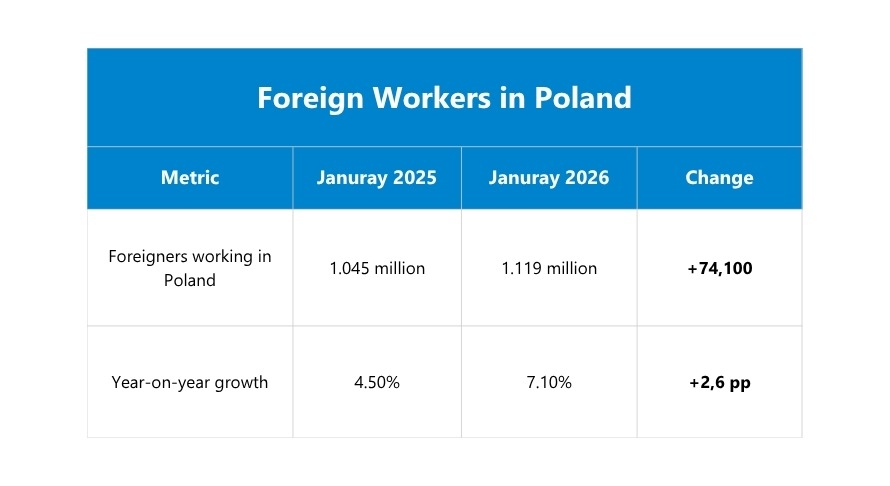
This shows that the growing presence of international workers in Poland is not a new phenomenon. Foreign employment has continued to expand, with tens of thousands of additional people joining the Polish labour market within just one year.
What this means for people planning to work in Poland
More than one million foreigners already working in Poland means that coming here for employment is an established path rather than an unusual choice. Polish companies increasingly employ international workers, while recruitment agencies and employers have gained experience with recruitment, employment formalities and onboarding of people arriving from abroad.
For someone considering Poland as a place to work, the latest figures are therefore an important signal: the foreign workforce is growing, and international employees are already a regular part of the country’s labour market.
Where do foreign workers in Poland come from?
Foreign workers in Poland come from an increasingly diverse range of countries. While migration from neighbouring Eastern European countries still represents the largest part of foreign employment, recruitment from more distant regions – particularly Asia – is becoming much more important.
This change means that Poland’s labour market is gradually becoming more international, with employers looking beyond traditional recruitment markets when they need additional workers.
Ukraine and Belarus remain the largest groups
Ukraine remains by far the largest source of foreign workers in Poland. According to the latest Statistics Poland (GUS) data, Ukrainian citizens accounted for 67% of all foreigners working in Poland at the end of January 2026. Their share has, however, gradually decreased as workers from other countries have become more common.
Belarus also remains one of the most important countries of origin. Together, workers from Ukraine and Belarus form a significant part of Poland’s international workforce, but the overall structure is becoming increasingly diverse.
More workers are arriving from Asia
One of the most interesting developments is the growing importance of Asian countries. Official data on documents legalising employment show particularly strong recruitment from the Philippines, India, Nepal and Indonesia.
In the first half of 2025, employment legalisation documents were issued or registered for approximately 17,600 Filipino citizens, 15,400 Indian citizens, 11,100 Nepalese citizens and 8,400 Indonesian citizens, according to the Ministry of Family, Labour and Social Policy. These figures refer to legalisation documents rather than the number of people actually working in Poland, but they clearly show how important Asian recruitment has become.
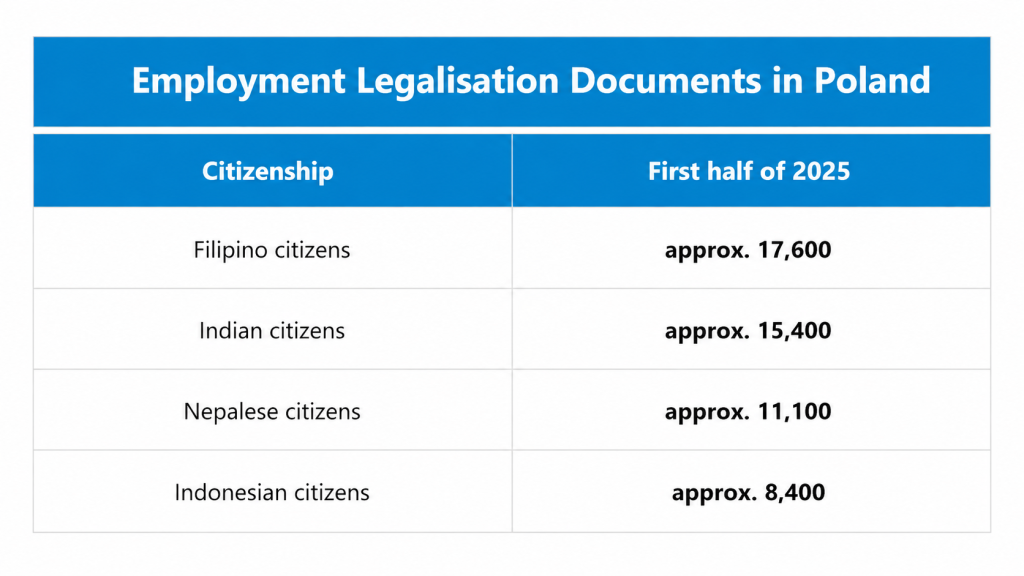
For workers from Asia considering employment abroad, this trend is significant. Poland is no longer a destination primarily for workers from neighbouring countries – companies are increasingly recruiting internationally, making workplaces with employees from different parts of the world much more common.
What jobs do foreigners find in Poland?
Foreign workers are employed across many sectors of the Polish economy, but demand is particularly visible in industries that need large numbers of employees and regularly experience recruitment shortages. For people planning to come to Poland, this means opportunities are available for candidates with different levels of experience and qualifications.
Production, logistics and warehouses lead demand
Production and logistics are among the most important sectors for international recruitment. Data from the Ministry of Family, Labour and Social Policy show that in the first half of 2025, 28% of documents legalising employment of foreigners concerned manufacturing, while another 22% were related to transportation and storage. Construction accounted for approximately 11%.
There is also significant demand through temporary employment and other business support services. This creates opportunities in jobs such as production workers, warehouse employees, machine operators, packers, assemblers and other positions supporting manufacturing and logistics operations.
Opportunities for both skilled and entry-level workers
Finding a job in Poland does not always require specialist qualifications or many years of experience. Many production, warehouse and logistics positions are available to candidates who can be trained after starting work.
At the same time, workers with professional skills can find opportunities in occupations such as machine operation, welding, construction, technical production or transport. The EURES Poland network also provides official information about employment opportunities and working conditions in Poland.
This combination makes the Polish labour market accessible to a broad range of foreign candidates – from people looking for their first job abroad to experienced workers searching for opportunities that match their qualifications.
Why more foreigners choose Poland for work
Poland has become an increasingly important destination for people looking for work in Europe. A relatively strong labour market, demand for employees in sectors such as production and logistics, and the growing number of international workers make the country a realistic option for people considering employment abroad.
The trend is visible in the numbers. In January 2026, 1.119 million foreigners were working in Poland, which was 7.1% more than a year earlier, according to Statistics Poland (GUS).
One of the lowest unemployment rates in the EU
Poland also has one of the lowest unemployment rates in the European Union. Eurostat reported an unemployment rate of 3.1% in Poland in 2025, compared with 6.0% across the EU. Only Czechia recorded a lower annual rate.
The situation remained similar in 2026. In April, unemployment in Poland stood at 3.0%, compared with 6.0% in the EU. A low unemployment rate does not guarantee that every newcomer will immediately find a job, but it shows that Poland has a relatively active labour market with high levels of employment.
A labour market increasingly open to international workers
The growing number of foreigners already working in Poland shows how important international employees have become for the country’s labour market. Companies recruit abroad particularly when they need additional workers for production, warehouses, logistics, construction and other sectors where local recruitment may not provide enough candidates.
For people considering moving to Poland, this also means entering a labour market that already has extensive experience with international employees. Foreign workers are increasingly common in Polish workplaces, and recruitment from countries outside Europe is becoming a more established part of the market.
Is Poland a good place for foreign workers in 2026?
The latest employment data suggest that Poland remains a realistic destination for people looking for work abroad. More than 1.1 million foreigners are already part of the Polish labour market, while employers continue to recruit internationally in sectors such as production, logistics, warehousing and construction.
Poland will not be the right choice for everyone, and working conditions, salaries and living costs vary depending on the job and location. However, for people looking for legal employment and the opportunity to build a more stable life in an EU country, Poland can offer a wide range of possibilities.
What to check before coming to Poland
Before accepting a job, check more than just the salary. Make sure the employment is legal, find out which documents you need to work and stay in Poland, and carefully read the conditions in your contract. You should also know your expected net salary, working hours, accommodation costs and whether health insurance is included through your employment.
Requirements may differ depending on your citizenship and type of work. Official information about entry, residence and employment rules for foreigners is available through the Office for Foreigners and the Polish government.
How Intraservis Job can help
Coming to another country for work involves much more than simply finding a vacancy. Intraservis Job helps foreign candidates find legal employment in Poland and supports them with the formalities required to start working.
We help candidates understand job conditions and salaries, prepare the necessary employment documents and complete the work legalisation process when required. Depending on the offer, support can also include accommodation and practical assistance after arrival in Poland.
This means you know where you will work, how much you can expect to earn and what conditions apply before starting your job.
If you are considering working in Poland, check the latest Intraservis Job offers and find a position that matches your experience and expectations.